
Three Mysterious Planets in the Universe
by Solar Choi (System) from 6C
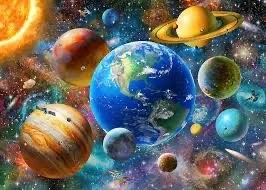
Let me introduce you to the different mysterious planets in the universe. But first, why should we know about planets? Scientists are trying to find planets that we can live on because someday, Earth's resources will run out! Perhaps we will live on Mars in the future?
1. Planet Nine (The Ghost Planet)
Scientists believe this is a hypothetical ninth planet lurking in the outer reaches of our solar system. 'Hypothetical' means something based on a theory or suggestion, rather than proven facts or direct observation. Scientists have not seen it yet, but they suspect it exists because of how its gravity pulls on smaller objects beyond Neptune. Planet Nine is nicknamed the "Ghost Planet" because it is a massive, invisible force that has never been seen directly, yet its "fingerprints" are visible throughout the outer solar system.
2. WASP-76 b (the hell planet)
WASP-76 was located 640 light years away; this "hell planet" is so hot that it rains molten iron. Temperatures on its star-facing side can reach over 2,400°C, vaporising metal that later condenses and falls as liquid iron on the cooler nightside. We don't have much further information about this planet because this planet is far away from us.
3. HD 189733 b (The Glass Rain Planet)
This cobalt-blue world may look peaceful, but it features supersonic winds blowing at 5,400 mph. The atmosphere is filled with silicate particles that condense into molten glass, which then rains sideways. Silicates are rock-forming minerals made of silicon and oxygen. HD 189733 b is called the "Glass Rain Planet" because of its deadly combination of chemistry and weather.
4. Kepler-22b (Earth 2.0)
This planet just looks like Earth. Trees, water, rocks and more. Kepler-22b is also called the "super-Earth". This planet was an exoplanet discovered by NASA's Kepler Space Telescope in 2011. It was the first planet confirmed to orbit within the habitable zone (the "Goldilocks Zone") of a Sun-like star. But you still can’t live there without an astronaut suit because of the high gravity and mysterious things inside the particles.
Among these, my personal favourite is Kepler-22b, thanks to its mysterious weather and the nickname of "Earth 2.0”. But what if Kepler-22b has the same oxygen and atmosphere? We could live there without a spacesuit! However, to get there, we need more space travel technology!